
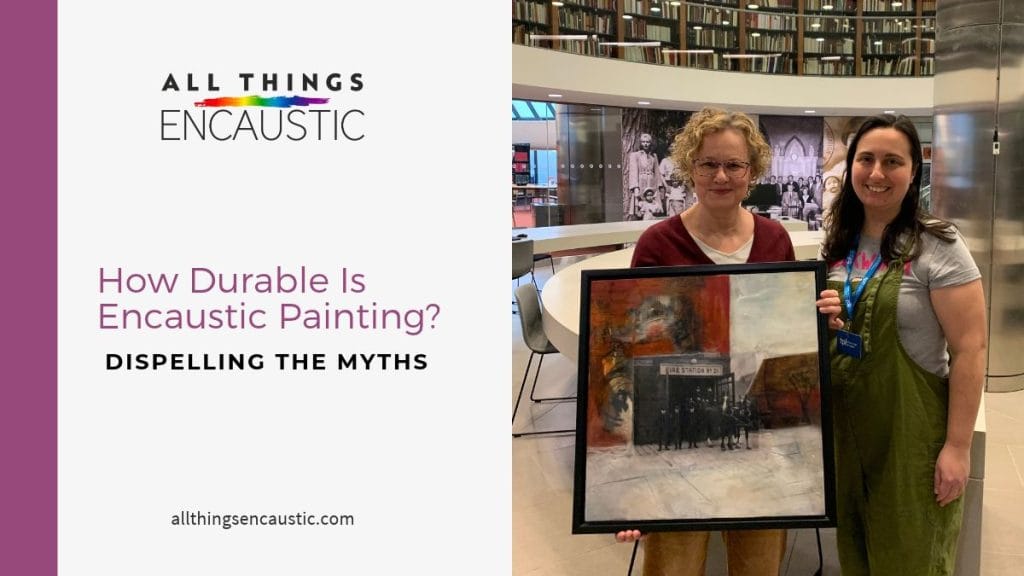
Today, I delivered my encaustic painting Station 21 to the Toronto Reference Library, where it will become part of the Canadian Documentary Art Collection. During our conversation, questions came up about the long-term care and storage of encaustic paintings.
It got me thinking about some of the questions I’ve been asked over the years by collectors, gallery owners and students.
How long can an encaustic painting last? Will it melt on a hot summer day? Will it attract dust? Will the wax eventually crack and fall off the panel?
Despite nearly 2,000 years of evidence of its longevity, encaustic is still perceived by some as a fragile painting medium. I’d like to address some of these concerns and misconceptions and explain what contributes to the durability of an encaustic painting.
How long can an encaustic painting last?
The Fayum mummy portraits of Roman Egypt are among the oldest surviving examples of encaustic paintings on wooden panels. Nearly 2,000 years later, they still retain vibrant colours and remarkable detail.
While Egypt’s dry climate contributed to their preservation, their survival is a remarkable testament to the longevity of the medium.
Interestingly, according to research compiled by R&F Handmade Paints, much of the cracking and paint loss seen in surviving Fayum portraits is attributed to the deterioration of the wooden panels rather than the ageing of the encaustic paint itself. This is an important distinction when considering the durability of encaustic.
Read more about The History of Encaustic Painting from Fayum Funeral Portraits to Today.
Why does encaustic have a reputation for being fragile?
I think some of the misconceptions about the durability of encaustic stem from conservation issues associated with prominent twentieth-century wax-based paintings.
During the modern revival of encaustic painting, artists experimented with different wax formulations, substrates and combinations of painting mediums.
In her 1999 exhibition catalogue essay, Waxing Poetic: Encaustic Art in America during the Twentieth Century, Gail Stavitsky documents some of these experimental approaches.
- Karl Zerbe experimented with combinations of waxes, resins and oils during the 1930s. Some of his early paintings cracked. He eventually settled on a mixture of 90 per cent beeswax and 10 per cent sun-thickened linseed oil.
- Arthur Dove experimented with wax emulsions and mixtures of wax, solvents and other painting mediums.
- Jasper Johns developed his own encaustic formulations using beeswax and tube oil paints and worked on both rigid substrates and stretched canvas.
- Brice Marden combined oil paint, beeswax and turpentine. Marden himself distinguished his technique from traditional encaustic, explaining that oil remained the primary binder in his paintings. He did not fuse his layers with an external heat source.
Jasper Johns and the importance of a rigid substrate
In a 1996 interview with Jasper Johns, conservator Carol Mancusi-Ungaro discusses the conservation treatment of his encaustic painting Gray Alphabets (1956).
The painting was originally on stretched canvas. Movement of the canvas placed stress on the collage elements, resulting in cracking and lifting. In 1985, conservators removed the painting from its stretcher and provided a rigid aluminium support behind the canvas.
This is a particularly good example of how the choice of substrate can compromise the structural integrity of an encaustic painting.
These artists made significant contributions to the revival and development of encaustic painting, but their materials and methods differ considerably from what we recommend for encaustic painting today.
It is unfortunate that conservation problems associated with some of these well-known paintings may have given encaustic an undeserved reputation for being fragile. When assessing the durability of an encaustic painting, we need to consider not only the wax but also the substrate, the ground, the formulation of the paint and the compatibility of all the materials used.
What makes encaustic paint durable?
In contemporary encaustic painting, we typically work with a combination of beeswax, damar resin and pigment.
Damar resin, a natural tree resin, is added to beeswax as a hardening agent. It raises the melting temperature, helps the encaustic medium harden over time, reduces wax bloom and produces a harder, more durable surface to which dust is less likely to adhere.
Read more about making encaustic medium.
Will encaustic paint crack or fall off the panel?
The choice of substrate for encaustic painting is critical. Encaustic paintings should be built on a stable, rigid substrate with a surface to which the wax can properly adhere. Stretched canvas and conventional acrylic gesso are not recommended for traditional layered encaustic painting.
R&F Handmade Paints has conducted extensive adhesion and durability testing on different substrates. Their findings demonstrate the importance of choosing and properly preparing the painting surface.
I’ve heard artists say that they aren’t concerned about whether their paintings will last thousands of years like the Fayum portraits. My response is that, at the very least, a painting should last the lifetime of the collector who purchases it.
When we sell a painting, the collector has a reasonable expectation that the work will last in good condition. As artists, we have a responsibility to understand the materials we work with and make informed choices about how we construct our paintings.
Will an encaustic painting melt on a hot summer day?
An encaustic painting hanging in your home under normal conditions will not melt on a hot summer day.
According to R&F Handmade Paints, pure beeswax melts at approximately 62–66°C (144–150°F), while their encaustic medium melts at approximately 70–74°C (158–166°F).
Homes and offices are temperature-controlled with heating and air conditioning, making them perfectly suitable for displaying encaustic paintings. As with any original artwork, avoid exposure to direct sunlight and excessive heat.
Can I hang an encaustic painting in a bathroom?
Encaustic paint is naturally water-resistant, so occasional steam from a shower or bath is not a concern. An encaustic painting can safely be displayed in a well-ventilated bathroom. The greater concern is the wooden panel, as prolonged exposure to excessive humidity can cause the wood to swell or warp.
What happens if an encaustic painting freezes?
While people often worry about encaustic paintings melting, exposure to freezing temperatures during transportation or storage is a greater concern.
Wax becomes more brittle at low temperatures. Differences in the expansion and contraction of the wax and the underlying substrate can cause cracking or delamination. This can happen even to a well-constructed encaustic painting made with compatible materials.
Living in Canada, I’m particularly mindful of this when shipping paintings during the winter months. Never leave an encaustic painting in a freezing vehicle or store it in an unheated studio where it may freeze.
If a painting has been exposed to extreme cold, allow it to gradually return to room temperature before unwrapping and handling it.
Will encaustic paintings get dusty?
In all the years I’ve had encaustic paintings hanging in my home, I’ve never had dust stick to the painted surfaces. The frames get dusty, but the paintings themselves don’t seem to attract dust.
The misconception may stem from the assumption that wax remains soft and sticky. The addition of damar resin to beeswax creates a hard, non-sticky painted surface.
If a cloudy or whitish film develops on the surface of an encaustic painting, it may be wax bloom rather than dust. Bloom is a naturally occurring phenomenon and is not, in itself, a sign that the painting is deteriorating.
On a smooth, stable encaustic surface, gentle buffing with a clean, warm hand or a soft, lint-free cloth can remove bloom and restore the sheen. The addition of damar resin to beeswax helps reduce the occurrence of bloom.
Does an encaustic painting need to be framed behind glass?
No, encaustic paintings on panel do not require glass. Although encaustic is durable, its surface can be scratched, dented or chipped if mishandled. I like to frame my encaustic paintings in floater frames, which helps protect the exposed edges and corners of the paintings.
How should I store encaustic paintings?
Whether you are an artist storing finished paintings in your studio, a collector rotating your artwork or an institution caring for a permanent collection, the same basic principles apply.
- Store paintings in a stable, climate-controlled indoor environment.
- Store paintings upright in a suitable storage rack with dividers.
- Protect the edges and corners of each painting.
- Ensure nothing comes into contact with the painted surface.
- Use glassine rather than bubble wrap to protect the painted surface when packing an encaustic painting
- Avoid extremes and rapid fluctuations in temperature and humidity.
- Never store encaustic paintings in a garage, attic or unheated storage unit where temperatures may become extreme.
Most of these precautions are not unique to encaustic. They are good practices for the storage of any original painting.
Encaustic paintings are made to last
Every painting medium has its vulnerabilities. Oil paintings can crack, acrylic paintings can attract and retain dirt, and watercolours can be damaged by moisture. We don’t consider these mediums unsuitable for creating lasting works of art.
Encaustic is no different.
As artists, we can contribute to the longevity of our paintings by choosing our materials carefully and following good painting practices. For collectors and institutions, it’s a matter of proper display, storage and handling.
I’m honoured to have one of my encaustic paintings in a permanent public collection. When I create a painting, I do so with the expectation that it will be enjoyed for generations to come.
After all, we’re still enjoying encaustic paintings created nearly 2,000 years ago.
References
Gail Stavitsky (1999). Waxing Poetic: Encaustic Art in America during the Twentieth Century. Exhibition catalogue essay, Montclair Art Museum.
- Early Twentieth-Century Encaustic — Arthur Dove and Karl Zerbe
- The Emergence of Jasper Johns
- Encaustic Art of the ’60s, ’70s, and Beyond
Carol Mancusi-Ungaro (1996). Interview with Jasper Johns, February 15, 1996. Artists Documentation Program, The Menil Collection.
R&F Handmade Paints:
Encaustic Technical Information — Temperature Chart
What Does Encaustic Adhere to Best? — Encaustic Substrate Testing