
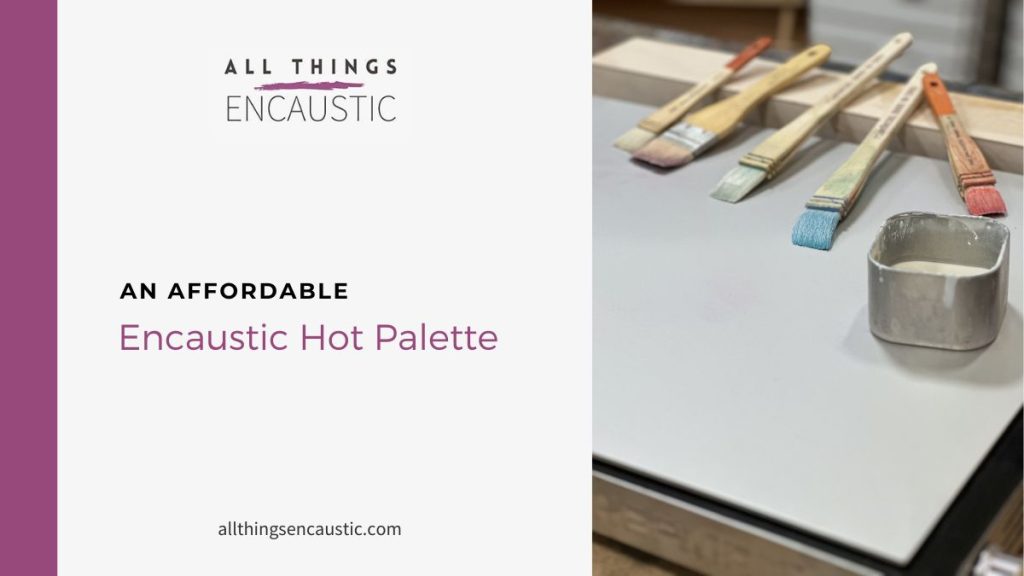
The Canadian Encaustic Conference Hot Palette Setup
Many of you have been asking about the encaustic hot palettes we use for the Canadian Encaustic Conference. In this post, I’ll explain what we used and why we chose this approach.
When planning the conference, we needed an affordable and reliable hot palette for multiple workstations. Power consumption was a major consideration. While pancake griddles work well for melting tins of encaustic, a room full of griddles can place a significant demand on the electrical system.
Purchasing two dozen commercially available encaustic hot palettes wasn’t in the budget, so we turned to warming trays paired with anodized aluminum plates. The combination worked extremely well for both painting and printmaking classes and demonstrations, providing artists with a large, heated surface for mixing colours, keeping encaustic medium workable, and supporting a variety of encaustic techniques.
What is an Encaustic Hot Palette?

An encaustic hot palette is a heated surface used to keep tins of encaustic medium and paint molten while working. Artists can mix colours directly on the hot palette and keep brushes warm for encaustic painting. A hot palette can also serve as a surface for creating imagery for encaustic printmaking.
Our hot palettes consisted of:
- A warming tray as the heat source
- A 16″ × 20″ anodized aluminum plate placed on top.
Advantages of Using a Warming Tray as an Encaustic Hot Palette
1. Lower Power Consumption
Many artists use electric pancake griddles as hot palettes for encaustic. While effective, a typical pancake griddle draws between 1,200–1,800 watts of power. Multiply that by a room full of artists and the electrical demand quickly becomes significant.
By comparison, the warming trays we used draw about 400 watts. For the Canadian Encaustic Conference, this lower power requirement allowed us to run numerous workstations simultaneously without overloading circuits or worrying about tripped breakers. It made the logistics of teaching large encaustic classes much more manageable.
For artists teaching workshops, hosting retreats, or working in shared studio spaces, lower power consumption can be a major advantage.
2. Affordable
A warming tray paired with an anodized aluminum plate is considerably less expensive than purchasing a dedicated encaustic hot palette.
For artists setting up a home studio or instructors outfitting multiple workstations, the savings can be substantial.
3. Large Working Surface
The anodized aluminum plate provides a generous 20″ x 16″ working surface for mixing colours and creating custom wax blends.
The smooth surface is easy to clean and offers plenty of room for brushes, colour mixing, and pots of encaustic medium.
You could push the sides of two warming trays together and lay a larger plate, 32″ x 22″, across them to create a double plate.
4. Suitable for Encaustic Painting and Printmaking

One of the things we appreciated most about this setup was its versatility for:
- Melting and mixing encaustic paints directly on the plate
- Keeping pots of medium molten
- Keeping brushes warm
- Encaustic monotype printmaking
The setup worked equally well for both encaustic painting and printmaking.
Encaustic Hot Palette FAQs
1. How Even Is the Temperature?
This is probably the most common question.
The temperature is not perfectly even and may vary widely from one warming tray to another. However, the anodized aluminum plate helps distribute heat across the surface and significantly reduces temperature variations. We use infrared thermometers to regularly check the temperature across the palette and ensure it remains within a safe working range.
In practice, we found the temperature consistency to be acceptable for both painting and printmaking.
2. How Do I Prevent the Plate from Sliding?
Another question that keeps coming up is how to keep the anodized aluminum plate from sliding on the surface of the warming tray.
We place a couple of sheets of blue shop towel between the glass surface and the underside of the plate. The shop towel provides enough grip to reduce movement while still allowing heat to transfer effectively.
3. Which Warming Tray Should I Buy?
For the conference, we used Chefman warming trays, which have tempered glass tops. Although glass can theoretically break, we have not experienced any issues. Since then, we’ve learned that the Magic Mill warming tray features an enamel-coated top rather than glass. If I were purchasing warming trays today, I would likely choose the Magic Mill simply to eliminate the risk of breaking the glass surface.
I also tried a Salton warming tray. While it worked for printmaking, it didn’t get hot enough to melt tins of encaustic medium.
How the Setup Performed at the Canadian Encaustic Conference
The warming tray and anodized aluminum plate system was used successfully throughout the conference in both painting and printmaking classes and demonstrations. Instructors and workshop attendees mixed colours, melted wax, and created encaustic monotypes on the same palettes. We operated many stations simultaneously, and we experienced no power issues and no equipment failures. For us, the setup struck an excellent balance between performance, cost, and practicality.
Get this Setup for Yourself
Use my affiliate links to buy a 21″ x 16″ warming tray on Amazon:
Anodized Aluminum Plate:
Upwards Art Studio is currently taking pre-orders (order before Aug 28) for anodized aluminum plates. Please note that shipping is not available. Pre-ordered plates must be picked up in Owen Sound or in Toronto.
What do you think?
If you’re looking for an affordable encaustic hot palette, a warming tray paired with an anodized aluminum plate is well worth considering. While it doesn’t provide the perfectly even heat of some dedicated encaustic hot palettes, it offers excellent functionality at a fraction of the cost. It uses relatively little electricity, provides ample mixing space, and has proven itself in both classroom and studio settings. For many artists, it may be all the hot palette they need.
Pick up your pre-ordered anodized aluminum plate from Upwards Art in Owen Sound or from me in Toronto.
Add a comment below to share your thoughts.



Hi, I’m still relatively new to encaustics (not 3-D sculptural encaustics, I’ve been doing that forever, but the more traditional painting) and I’m a little confused why an anodized aluminum plate needs to be put on top of the various options for food warmers. If they have a glass, or better yet enamel or ceramic top they should heat extremely evenly (I rather think having the aluminum plates on top is what made the setup not perfectly even) and be very easy to clean up from the hot wax at the end of a work session. And the link to the Magic Mill at least already shows it as I think 21” x 16” so you aren’t getting additional space really. I guess I’m not clear on the advantages when it seems to me it would be more even heat wise and you also wouldn’t have to worry about there being any wobliness between the two.
I’ve just moved to France and therefore need to upgrade my system from an ancient pancake griddle my mom gave me to something with a French plug, as I just don’t trust an old griddle’s electrical system with an outlet adapter (I’ve had too many just low power fans burn out on me, I worry something like a griddle might lead to fire. I was going to just shop for pancake griddles at the many thrift shops there, but now I am quite interested in the food warmers. Do you have any advice for what to look for when purchasing a thrifted version in the EU (like making sure it can get warm enough or surfaces or anything else- a built in thermometer would be nice but I already have a flat one for directly measuring.
I have no idea where in my little region of France to go looking for an anodized aluminum plate, other than online and I’d rather really buy used! Thanks!
Hi Aubrey,
If you’re melting wax in tins, you can use a warming tray without an anodized aluminum plate. If you want a hot palette to melt and mix encaustic paints on, you’ll need the plate to be able to see the colours. For encaustic printmaking, an anodized plate also works well. I’m in Canada, so I don’t have any EU sources to offer. You can ask others in the Facebook group.
Oh yes, I mix up my own paints, as well as my own custom mediums, I have so far not actually purchased any of the premade paints. I make mine with my custom mediums and Sennelier oil paints (& sometimes some of the Sennilier & the occasional RF oil wax sticks). I had been doing so on the old griddle, in small tins I save from my cats’ very expensive wet food (they are quite the perfect size, there is a never ending supply, & I might as well get some additional use considering how much their food costs in comparison to mine!). I could generally see the color in those as they are aluminum, & I got used to just trying the color out on a scratch piece of whatever surface I am using. It honestly never occurred to me to put something as big or bigger than my griddle to be able to see the colors better. Often I just put the paints on white waxed butcher paper, which it sometimes just slides off of and I can slip in back onto the griddle & use it. I haven’t had a chance to get to any thrift stores in France the last couple months but now that I know about this I will keep my mind open for a different potential setup, depending on what is offered there. Griddles in general are very popular at grocery stores & markets & the various stores that in France are as close to a Target in the US, I’m not sure what the store you would have in Canada is? So I’m assuming that they have a lot of them at thrift stores- I’m not sure I’ve seen many of these types of food warmers or anodized aluminum surfaces, but I will pay more attention for them & start looking in the various online alternatives to Amazon they have. Thanks always for your great blog, it has really helped me get started on this painting journey- still wish I could use a flexible support, just for shipping/transport (& wooden supports getting so expensive when you get large scale!). For me it’s usually a lot cheaper to make my supports out of porcelain…
I’ve been using a similar setup for a few years. It works very well. I use a large, German-made ceramic warming tray with very good thermostatic control, and a 3mm anodised aluminium plate from Jackson’s of London.
Helen, I’m in France, are you in Europe too or in North America? Just wondering more about what brand your German made ceramic warming tray is and how large it is and if the ceramic top is light enough for you to see paint colors on & do monotype prints on or if the aluminum plate is necessary…I’m also thinking about doubling up and putting two together like is suggested in the blog, as I tend to go big or go home when it comes to as much of my work as possible and it would be nice to print much bigger monotypes!
how thick is the anodized aluminum plate?
Hi Stephen, It is .125″ thick
Are the anodized aluminum plates custom made or available commercially?
They are custom-made and available for preorder from Upwards Art. You can pick them up from them in Owen Sound or from me in Toronto.
Anodized aluminum plates in several sizes are also made by Enkaustikos, and are easily found at various online stores with shipping. I’ve been using them with a pancake griddle. The heat control isn’t as precise as a dedicated encaustic plate, limiting control when making encaustic prints, but works well as a palette.
Thanks for your super resource-laden website!