
Too often I’ve purchased a beautiful sheet of washi (Japanese paper), only to come back to it later and realize I have no idea what it is.
Was it Kozo? Gampi? Machine-made or handmade? Which paper worked well—or not at all?
When pulling prints, the way the paper and wax interact matters. How the paper absorbs the wax, holds a line, and softens or sharpens an image—these qualities vary widely from one sheet to another. And unless you track it, that knowledge is easily lost.
For an overview of different papers to try, see Selecting Japanese Paper for Encaustic Printmaking by Nancy Jacobi, founder of The Japanese Paper Place. Here, I’m focusing on something different—how to track, document, and build a reference system so you can remember what works.
A Simple System for Tracking Washi
Over time, I’ve found a few ways to keep track of the papers I use.

1. Label your paper
Write the name of the paper in pencil on the bottom corner of the sheet. When you cut the paper smaller, write the name again on each piece—so you don’t lose track.
2. Photograph your prints
Write the paper name on a small piece of paper and place it above or on the finished print. Take a quick photo. This way, you’ll always be able to match the print to the paper without guessing—even if your pencil marks become obscured.
Years later, I can still find these images in Google Photos and confirm that the paper matches the print.
Latitude #2
Encaustic monotype on Oguni Snowbleached Kozo
by Ruth Maude

3. Create a Washi Paper Reference Book
My good friend Amelia Kraemer showed me their washi sampler book, and now I’m adopting this approach for myself.

I use a simple sketchbook where I mount small samples of each paper. The key is to leave the paper loose so you can lift the edge and feel it with your fingers. Alongside the paper sample, I include handwritten notes.
In this sampler, I note:
- Paper name
- Fibre content (kozo, gampi, mitsumata, etc.)
- Whether it is handmade or machine made
- Weight (gsm)
- Anything I want to remember about how it interacted with the wax
4. Washi Collections
You’ll want to experiment with a variety of papers to find your favourites for encaustic printmaking.
The Japanese Paper Place in Toronto sells Washi Collections—ask for these wherever you buy paper.
Choosing from hundreds of papers can be overwhelming, but these packs help narrow the selection.
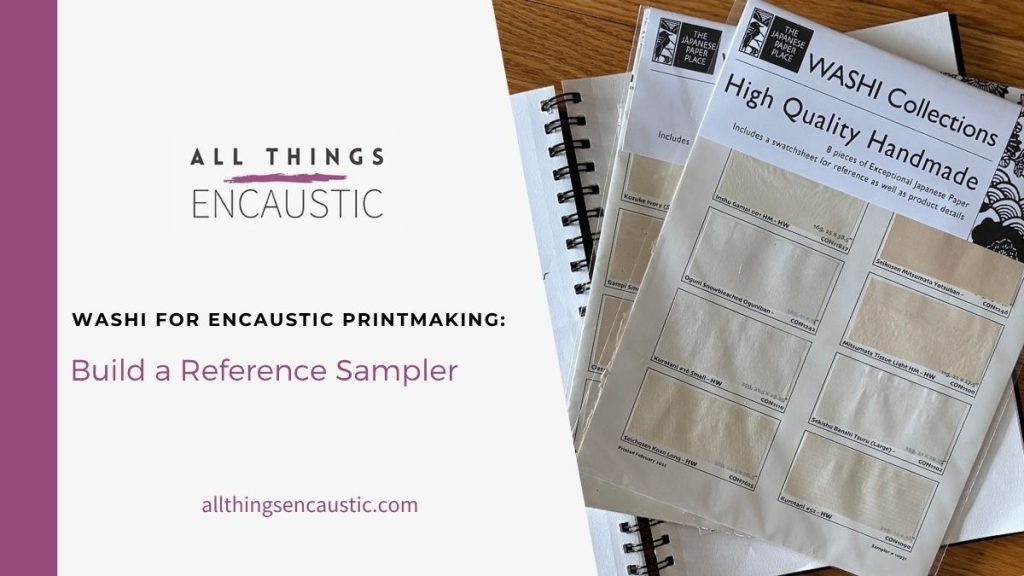
These are a great way to jump-start your sampler book. The collections I bought contain eight different sheets of Japanese paper along with a swatch sheet and technical details about each one.
I’ll add the swatch sheets to my reference book and write notes alongside as I test them out.

Buying Japanese Paper
The paper you choose isn’t just a support—its beauty is an integral part of the artwork. Being able to properly attribute the paper honours it.
The Japanese Paper Place partners with resellers around the world to make fine Japanese papers available locally. Contact a local reseller for your Japanese paper needs. Resellers are listed on the JPP’s website: https://japanesepaperplace.com/.
In the US you can order their papers online through washiarts.com



Brilliant! I “almost” successfully made a record….